
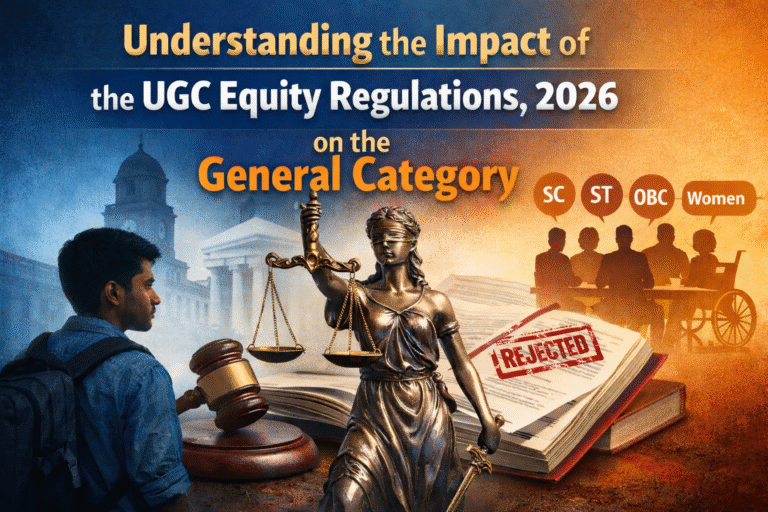
A system that protects dignity by destroying due process ultimately protects neither.
The University Grants Commission (Promotion of Equity in Higher Education Institutions) Regulations, 2026 were notified with the stated objective of eradicating discrimination and promoting inclusion in higher education institutions. The government’s intention to create a dignified, non-discriminatory academic environment is constitutionally laudable.
Nevertheless, a law is not only judged by intent but also judged by its design and outcomes. Upon a closer examination of the Regulations, though they do not actively bear out the discrimination of the General Category, they do indirectly establish an unequal and fear-based ecosystem that disproportionately weighs down on General Category students and faculty.
This article discusses how a biased regulatory structure, lack of protection, and an imbalance in the process can cause systemic damage to the General Category even though there is no explicit exclusion. This discussion does not challenge the need of such protections to disadvantaged groups, but looks into whether procedural protections are balanced enough to guard every stakeholder.
1. Equity Without Reciprocity
There is a structural imbalance in these regulations. The Regulations repeatedly emphasise protection of “disadvantaged groups” such as SC, ST, OBC, Women and persons with disabilities. Institutional mechanisms such as Equal Opportunity Centres, Equity Committees, Equity Squads are primarily designed to:
- assist the disadvantaged sections,
- to prepare inclusive admission procedures for them,
- and to mobilise resources specifically for them.
However there is no corresponding statutory mandate to:
- protect General Category individuals from false or malicious complaints,
- to ensure neutral representation in adjudicatory bodies,
- and to compensate or restore reputations of those falsely accused.
This creates asymmetrical accountability, where one group enjoys institutional protection while another bears institutional risk.
2. Overbroad Definition of “Discrimination” and Legal Vagueness
The Regulations have established the meaning of the word discrimination to include:
- implicit conduct,
- perceived indignity,
- acts having the “effect” of impairing equality or dignity.
This is an extremely broad and subjective definition. In legal terms, this creates:
- vagueness, by penalising unstated or inferred behaviour or conduct, the law punishes intention assumed by the observer rather than conduct proved by objective evidence.
- scope for arbitrary interpretation, When indignity is judged by subjective perception, liability depends on personal sensitivity instead of a uniform legal standard.
- uncertainty in everyday academic conduct. Focusing on consequences rather than intent makes even neutral, lawful actions actionable if they are later claimed to have an adverse impact.
Ordinary acts like:
- strict grading,
- academic criticism,
- denial of extensions,
- disciplinary action
can be retrospectively framed as discriminatory, particularly when caste or social background is later introduced into the narrative.
3. Low Threshold Complaints and “Process as Punishment”
A complaint under the Regulations can be filed:
- online,
- by email,
- through a helpline,
- with confidentiality of identity if requested.
The Equity Committee must convene within 24 hours.
This ensures speed, but it sacrifices procedural maturity:
- no preliminary scrutiny mechanism,
- no filtering of frivolous complaints,
- no cooling-off period.
For General Category respondents, this means:
- suspension of academic activities,
- reputational damage,
- psychological distress,
- career stagnation.
Even if exonerated, the process itself becomes the punishment.
4. Committee Composition and Perception of Bias
The Equity Committee must include representation from:
- SC,
- ST,
- OBC,
- PwD,
- women.
While the representation is vital, there is no requirement of balanced or neutral representation, nor any express safeguard against conflict of interest.
In disputes involving General Category respondents:
- the adjudicatory body is structurally aligned with the complainant’s identity group,
- the perception of impartiality is compromised,
- confidence in natural justice erodes as it is a strong chance of Bias.
Justice must not only be done, but must appear to be done.
5. Faculty Under Siege
These regulations also contribute to the collapse of Academic Authority. For General Category faculty, the Regulations pose a unique threat. As Under the complaint procedure:
- matters may be forwarded to police if a prima facie offence appears,
- without scrutiny,
- without safeguards against abuse.
This may result in:
- avoidance of strict evaluation,
- dilution of academic standards,
- reluctance to mentor or discipline students,
- inflation of grades as a defensive mechanism.
The Academic freedom is an essential component of higher education and due to these regulations it will be replaced by defensive teaching.
6. Absence of Penalty for False or Malicious Complaints
One of the most critical omissions in these these regulations is that there is
- no punishment for false complaints,
- no inquiry into malicious intent,
- no compensation for the falsely accused,
- no mandatory expungement of records.
This creates moral hazard. This can be said so because:
- complainants have nothing to lose,
- respondents have everything to lose.
A rights-based regime without responsibility is inherently unjust.
7. Institutional Over-Compliance and Scapegoating
Non-compliance with the Regulations can lead to:
- debarment from UGC schemes,
- withdrawal of degree programmes,
- removal from UGC-recognised lists.
Faced with such existential threats, institutions may be forced to:
- side with complainants,
- sacrifice individuals to demonstrate compliance,
- prioritise optics over fairness.
General Category students and faculty become institutional shock absorbers.
8. Social and Psychological Consequences
Beyond legal harm, the Regulations foster:
- presumption of privilege-based guilt,
- silencing of dissent,
- erosion of inter-group trust,
- psychological trauma of constant vigilance.
While the Regulations recognise trauma of complainants, they entirely ignore trauma of the falsely accused, violating the dignity principle under Article 21.
Conclusion: Equity Must Be Balanced With Fairness
The UGC Equity Regulations, 2026 do not explicitly discriminate against the General Category. However, their design, implementation mechanisms, and omissions collectively produce indirect discrimination.
True equity requires:
- symmetry of rights and duties,
- safeguards against misuse,
- protection of academic freedom,
- adherence to natural justice.
Without corrective amendments, the Regulations risk transforming higher education into a compliance-driven, fear-dominated space, undermining both merit and trust. Equity cannot be achieved by replacing one imbalance with another.
